Showing posts with label Bf109G-10. Show all posts

Friday, January 2, 2026

White 1 of Paul Schalk, 5./JG11


White 1 of Paul Schalk is featured in three photos in Priens "Jagdfliegerverbände der Deutschen Luftwaffe Teil 16/1" although it's misidentified as a G-14/AS. It's actually an Erla built G-10. The aircraft shows traces of repainting in several places and the fuselage cross is slightly skewed. The yellow fuselage band of JG11 seems to have been overpainted with RLM 75 unless the yellow colour has the exact same tonal value as the 75 which is possible but unlikely. So, it's another late war aircraft painted to look as dull as possible. 
 
It's possble that White 1 was flown looking like this with the yellow fuselage band in place, but as there's also signs on the fuselage that the tactical number has been replaced at one time or other it's impossible to know for certain.

Tuesday, December 2, 2025

Gelbe 8 - another dull, late-war aircraft, or...?


I started looking into Gelbe 8 due to a discussion on social media, an aircraft that I've known about for a long time but never looked at closer as it honestly looked quite dull. 

Coming back to it after having spent considerable time on learning the paint schemes of various factories and their W.Nr batches, this one actually has some very interesting details. First, the contrast between upper colours suggests a camouflage of 75 and 81, which is rare for an Erla built aircraft. What is more rare is the fin, it's painted like a typical fin from a Mtt Regensburg aircraft, NOT a typical Erla built aircraft. 

As if that wasn't enough, there's a slight curve to the panel line below the windscreen! These unique features makes me wonder if this aircraft in it's relatively short career had a visit to a frontreparatur for a check up that included some fresh paint and some body work. 

Found at Ainring after the war, it's believed to have been a III./JG300 aicraft possibly flown by Jochen Stiege.  

Monday, December 30, 2024

Bf109G-10 of Heinz Ewald


EDIT - The link was broken so I updated this profile to my latest standards. 

This WNF-built Bf109G-10 was flown by Heinz Ewald of II./JG52 in February 1945. Pictures, decals and a profile are provided by Kagero for this aircraft and Hasegawa has boxings of this aircraft as well. Both Kagero and Hasegawa depicts this aircraft in late-war colors and a camoflage that looks close to the pattern used on late Bf109K-4's.

The internet is full of pictures of models depicting this scheme that is unfortunately incorrect. I was sceptical of that scheme from the start and when I started learning about Wrk.Nr ranges and how camoflage patterns could be used to understand from which factory a Bf109 came from I just knew something was wrong. WNF never used the kind of pattern that Kagero and Hasegawa suggests.

Finally when I found pictures of this aircraft, nothing in them contradicted a standard WNF camo as depicted in my profile. Sure, the fuselageside might have had some extra mottling but nothing like the solid, low demarcation scheme shown in the instructions from Hasegawa and Kagero.

A big shame since it's quite an attractive idea, I believe that my version is far closer to the truth - which still might be a bit off!

The numerals provided by Hasegawa and Kagero are too large, they should be in the same size as all other II./JG52 aircraft wore in the spring of 1945 and seen for example on the aircraft found at Neubiberg at the wars end.

One final thing to notice is that the landinggear doors had been removed to prevent snow and mud from getting caught up between the doors and the leg.

Sunday, April 4, 2021

Bf109G-10 from JG301


Finally I've found my self between projects and with some spare time to do a profile for my own enjoyment! The subject is based on recently discovered photos of this Erla built Bf109G-10 serving with 14./JG301 at Gahro. The camouflage appears to be the standard RLM 74/75 but with an additional darker colour on the spine above the balkenkruez and the rear of the aircraft. 

The blog is not dead! It's only resting...

Thursday, October 23, 2014

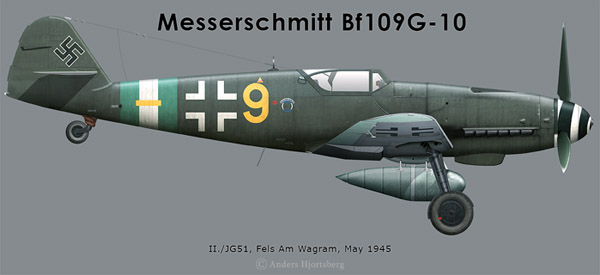
JG51 Bf109G-10 at Fels am Wagram

http://www.cptfarrels.com/blog/Bf109G-10_Erla_Yellow_6_JG51_1200.jpg
Recently found photos from Fels Am Wagram in May 1945 shows a number of Bf109G-10's carrying fuselage bands with a white centre flanked by bands in a medium colour. These aircraft also carried the horizontal band of a II Gruppe unit applied on top of the fuselage bands. These markings are close in style to those of Jagdgruppe 300, but aircraft of that unit seems to have carried a small black horizontal band regardless of staffel colour. 

As II./JG51 was disbanded at Fels am Wagram in april, these aircraft may well be the first known examples of the use of the green - white - green fuselage band assigned to JG 51.

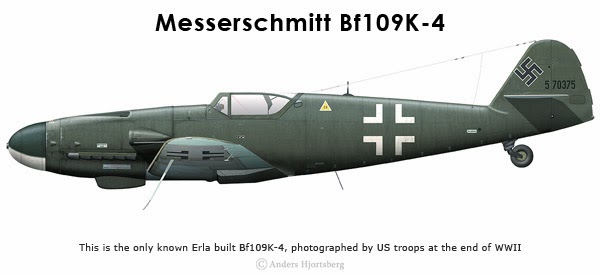
An Erla built Bf109G-10 with the shorter tail wheel is also rare. The short wheel seems to have been used on some aircraft late in the production though. A notable example being the only known photographed Erla built Bf109K-4.

Thursday, March 27, 2014

Bf109G-10 Red 2 of 5./JG52

http://www.cptfarrels.com/blog/Bf109G-10_Red_2_JG52_1200.jpg
While researching "Black 22" for the Barracuda decal sheets I came across a loss list entry for 5./JG52 showing a WNF built Bf109G-10 maked "Red 2" rather than the usual black. Pictures in Prien & Rodeike shows an aircraft marked "2" in a medium color that match the details quite well. 

The pictures were reportedly taken at Vezsprem in March 1945 which is also when the aircraft was lost. The pictures show a spiral spinner with a background lighter than both black and RLM 70 which is why I opted for red spinner to go along with the numeral and the fact that there seems to be eye-witness accounts of red occasionally beeing used for spinner in 5./JG52.

Wednesday, March 19, 2014

Barracuda Cals Sheet 1 Black or Blue 22?

http://www.cptfarrels.com/blog/Bl22.jpg


On Barracuda Studios decal sheet "BC32144 Erla Bf 109G-10 - Part 1" we've included a II./JG52 aircraft marked "Black 22". There is some doubt about the color of the numerals though as they look a bit paler than one would expect from black numerals. This could be explained by a glossy black paint used for the numerals or even a glossy fuselage that combined with a low setting sun reflects the light in such a way that creates this pale effect.

Turning to documental evidence, more precisely the losslist of II./JG52, it is clear that normally II./JG52 used White, Black and Yellow numerals. There's also a single mention of red, "Red 2", a WNF built Bf109G-10 that was lost on March 15:th 1945. A photo of a WNF built Bf109G-10 marked with what is likely a red "2" exists and shows that the red was used without outline. So based only on the losslist, Black 22 would seem like the most likelt candidate for the markings.

Another possibility comes from the fact that here was an 8./JG52 formed as part of II./JG52 for at least a month in early 1945. In other words it's likely that at least for a while, a fourth staffel color was used within II./JG52. Given the relative dark tone of the numeral on "22" I believe it's safe to rule out RLM 25 but RLM 24 could be an option. The problem is that not a single loss for an 8./JG52 aircraft can be found in the losslist, but there are also several losses that are simply noted as "II./JG52" without mention of neither Staffel number nor tactical number or color. So while the losslist doesn't prove the existance of blue numerals it can't be used to rule them out either. 

If the aircraft was marked Blue 22 due to it being part of 8./JG52 it would have been flown by another staffel of II./JG52 during the spring of 1945 as by the time the yellow rudder and band around the nose were applied, 8./JG52 was already disbanded.

That's all that is know at the moment. Hopefully something will emerge in the future to shed light on this little mystery but for now, this is it. We supplied the option, above is the explanation, the decision is off course yours and yours alone. Have fun!

Barracuda Studios Bf109G-10 Erla decals - additional comments on camouflage


Most Erla built Bf109G-10’s seems to have been camouflaged in the regular Luftwaffe camouflage scheme of RLM 74/75/76. A few colorphotographs as well as written descriptions in the “Crashed Enemy Aircraft Reports” supports this. 

Beginning somewhere in the 151xxx W.Nr batch another scheme was introduced that stands out clearly against the regular schemes. These schemes must have been the results of the requirements on factories to save on both labour and raw materials. The entire fuselages including the undersurface was painted in a very dark color, most likely RLM 81. In some instances a second lighter color, that if the rules were applied, would have been RLM 82 was sprayed on top of the RLM81 to create a camouflage pattern. Such a scheme gives a very low contrast in B&W photos and is often hard to discern.The wings of these aircraft were also painted in the same dark color on the uppersurfaces, while the undersurfaces were left in natural metal with only wooden and canvas components painted RLM 76.

The latewar colors
Docuements recently found in German archives by Michael Ullmann has revealed some startling facts about the so called latewar colors. RLM 83 was according to these documents not a dark green as has been previously believed, but rather a dark blue color intended for use at unit level on bombers operating over the Mediterranean sea. 

So the latewar colors seen on fighters must have been different variations of RLM 81 and RLM 82. The documents found by Ullmann shows that RLM 81 and RLM 82 were both developed from green colors, RLM 81 being described as Olive Green while RLM 82 was described as Bright Green. The document goes on to describe that new colors 81 and 82 (Brown tint) were introduced as well. This points to brown versions of BOTH RLM 81 and RLM 82 being tested. 

There is little doubt that a green version of RLM 81 was produced as there’s even been a can found in the Czech republic labeled 81 but containing a dark green paint. So most likely, instead of a transition period where RLM 83/82 schemes were replaced with RLM 81/82, it now seems as if it was RLM 81/82 all the time, but that the RLM 81 changed from dark green (or olive green) to brown violet. 
The so called 83/81 scheme would, following the same logic, be dark green RLM 81 with brown tint RLM 82. There’s no proof of this but it could certainly explain why there’s a brown color that is slightly darker than green 81 but also a brown significantly lighter than green 81. 

That would mean that an RLM 81/82 scheme could actually be a number of combinations and for the Erla built G-10’s I’ve used Olive Green and Bright Green as that’s the combination that would likely give the lowest contrast.  Until a colorphoto emerges of these aircraft, these theories are as close as one can get.

For modeling purposes, the olive green or dark green is matched by most brands by the “RLM 83” designation, Gunze for example being spot on. LifeColor has an RLM 81 that they call Brown Violet but in reality it is dark green. Green RLM 81 is also matched by RAL 6006 and FS 34083.

http://www.cptfarrels.com/blog/Bf109K-4_Erla_1200.jpg
Monotone RLM 81 Erla camouflage

http://www.cptfarrels.com/blog/Bf109G-10_Erla_Abandoned_1200.jpg
RLM 81 / 82 Erla Camouflage

Sunday, January 26, 2014

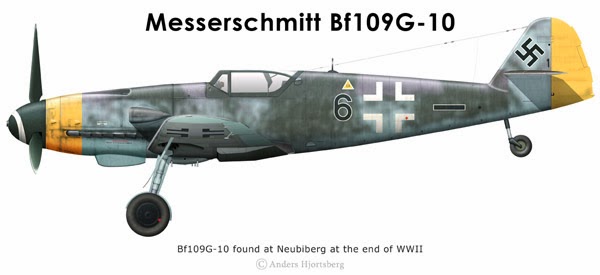
Erla built Bf109G-10 at Neubiberg

http://www.cptfarrels.com/blog/Bf109G-10_Erla_Black-6_JG52_1200.jpg

Finally, thanks to the work or Marc-André Haldimann, a good photo of Black 6 at Neubiberg has been found. The resemblances with Black 22 are striking in that both aircraft shows a quite heavy overspray on the fuselage. This aircraft is also from 151xxx W.Nr range judging from the large rectangular wheelbulges and the antenna wire that is attached directly to the fuselage spine rather than an antenna post.

Monday, November 18, 2013

Erich Hartmann's Bf109G-10

http://www.cptfarrels.com/blog/Bf109G-10_Erla_Hartmann_1200.jpg
A month ago I would have sworn to anyone that would listen that there was no way that Erich Hartmanns last Bf109 would be wearing the black tulip on the nose as it would have been too dangerous to wear and too time-consuming to paint given the situation on the eastern front. Then a man finds a photoalbum at a market and by a stroke of luck he knows the significance of the photo he's got in front of himself and all the sudden there's proof that Hartmann's G-10 did indeed have a black tulip painted on the nose! Everything aft of the fuselage cross is still guesswork though but contemporary I./JG52 aircraft show no yellow bands or rudders. The fuselage cross is in the smaller size introduced by Erla somewhere during the production run of their G-10 series. It's not certain that the undersurfaces of the wings were natural metal though.

I first found the photos of the aicraft at Neil Page's blog here  They were originally found and posted by Flavio at the Luftwaffe Experten Messageboard

Updated 18/11 2013: Updated the profile in preparation for the release of the Revell Bf109G-10 Erla that will contain decals for this aircraft. According to the boxart Revell has likely got the tailfin camo wrong as they depict a style used by Mtt Regensburg that was rare on Erla built aircraft. I've changed the fin too as the camo I depicted earlier seems to have been a rare case and not as typical as I first thought.  

Monday, November 11, 2013

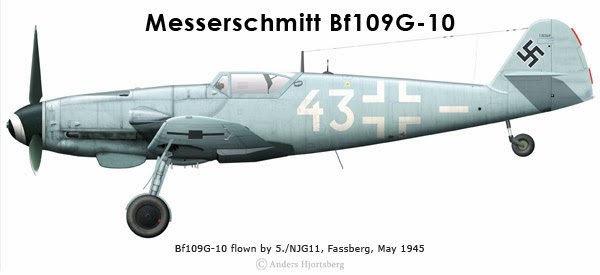
Messerschmitt Regensburg Bf109G-10

http://www.cptfarrels.com/blog/Bf109G-10_Mtt_White-43_1200.jpg
This is a rare Bf109G-10 built by Mtt Regensburg as can be confirmed from the W.Nr 130369 but modified for night fighting duties with 5./NJG11. Flame dampers has been fitted to the exhaust stacks and the fuselage has had it's panellines carefully puttied, sanded and polished for some extra speed. This work seems to have been in the field as the airframe is almost completely devoid of stencils. Additionally there's a small sliding section of perspex on the side of the canopy which is another non-standard item. Finally, the missing battery box on the rear cockpit bulkhead is an indication that there might have been some internal changes done as well. 

For the background story and hi-res photos of this aircraft go to Neil Pages FalkeEins Luftwaffe Blog All the info on this aircraft comes from him.

Friday, November 8, 2013

WNF Built Bf109G-10 at Neubiberg

http://www.cptfarrels.com/blog/Bf109G-10_WNF_Black_Chevron_1200.jpg
Seeing how the Erla built G-10's has been featured so much on the blog lately it's time for a WNF built Bf109G-10. This one is one of the many that were surrendered at Neubiberg in May 1945. The Luftflotte 4 markings have been hastily applied freehand on the nose. One can always wonder whether the "smiley face" on the quarter panel behind the enginecowling was intentional! 

Friday, November 1, 2013

Barracudacals Erla Bf109G-10's

The following decalsheets in 1:32 will be released by Barracuda Decals for the upcoming Bf109G-10 Erla from Revell. Some of these aircraft has been featured on the blog before, while others are brand new and created for these sheets. Big thanks to all who's helped in my research and made these profiles as accurate as possible. Keep an eye on the blog for further news and the inevitable errata...


Sunday, October 27, 2013

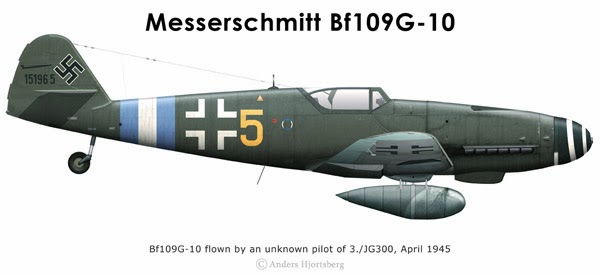
Erla Bf109G-10 from JG300


http:/www.cptfarrels.com/blog/Bf109G-10_Yellow_5_JG300_1200.jpg


This is another one of those dark painted, Erla built Bf109G-10's. In this case there seems to be only one color on the upper surfaces, the small differences more likely being the result of weathering and a slightly uneven paint application. The newly released promopicture of the coming Revell Bf109G-10 seems to show this scheme, but with the wrong enginecowling as the boxart shows it in 74/75/76.


W.Nr comes from Jörg Meincke via Marc-André Haldimann. Also, credit goes to Jörg Meincke for correcting the caption.

Monday, September 16, 2013

Another dark color Erla built Bf109G-10


http://www.cptfarrels.com/blog/Bf109G-10 Black 13 JG27_1200.jpg


Another Erla built Bf109G-10 found abandoned after the war. The interesting thing about this one is that although it appeared to be painted in a single color at first, just like the previously posted G-10, at a closer look there seems to be two colors. Not only that but they would seem to fit the pattern seen on the left hand side of the previously posted aircraft.


UPDATE: Franck Benoiton and Marc-André Haldimann disussed whether this aircraft that I previously believed belonged to JG11, might in fact have been a JG27 aircraft. Having given this some thought I started checking contemprary aircraft from the two units and though material on JG11 is scarce, the few photos showing latewar II./JG11 109's that exist doesn't show any tailbands. JG27 on the other hand displayed them to the end of the war in similar fashion to what can be seen in the picture. So unless any new information turns up, for the time being I'll settle for JG27 as the unit of this aircraft.

Sunday, October 28, 2012

JG1 Erla built Bf109G-10


This Erla built Bf109G-10 might possibly be the most featureless profile I've done. Discreet was the order of the day when this aircraft was flown by Lt. Hubert Heckmann of 9./JG1 at Anklam in March 1945. 

Photos in Eric Mombeek's "Defenders of the Reich" volume 3 show this aircraft with the lower gear doors removed to prevent build-up of mud. According to the caption the aircraft was marked "White 13" but only the "1" is visible so the shape of the "3" is based on other aircraft from JG1. The aircraft seems to be from the 491xxx or 150xxx W.Nr. batches and I've painted it accordingly. During this period the transistion to unpainted wing undersurfaces had begun but it's hard to tell whether this aircraft had them or not. 

Monday, October 3, 2011

Erla built Bf109G-10 found at the end of WWII

This is one of the Bf109G-10's made by Erla with a very dark, almost uniform camoflage. It is possible that some or all of these machines were actually painted in a singel color but faint demarcationlines in several photos makes me believe in a two tone camo. A cloudy pattern of RLM 81 and RLM82 would certainly look dark, almost uniform in black and white. Especially so if the late war practice of spraying the darker color first was used on this aircraft.