Showing posts with label JG1. Show all posts

Sunday, November 30, 2025

JG1 in Normandy - Friedrich Zanders Blue 22

 
During its time in Normandy after the invasion, the Gruppenstab of III./JG1changed its markings from white numerals to blue. There's photos of Blue 22 and Blue 23 that shows this practice which is also confirmed by the loss lists. 

The photos of Blue 22  shows the area below the cockpit up to and including the numerals and a part behind the Balkenkreuz. The camouflage and stencils proves that Blue 22 was built by Mtt Regensburg and the III./JG1 loss lists shows several aircraft in the 165.xxx W.Nr batch. 

Details in the paintwork seems to confirm this, pointing towards the tall tail version found within the 165.xxx batch. I've finished the profile accordingly. Although markings were simple during the Normandy campaign, most aircraft seems to have had spinner spirals applied as it was an important I.D. marking.


Monday, February 11, 2019

Bf109F-2 of Stab JG1

https://drive.google.com/file/d/19lQyBZ8Cp9Hz20ELCNxCHahA4Wl4YnZg/view?usp=sharing
This Bf109F-2 has a very unusual paint scheme for a Bf109F serving in the west. Thanks to the knowledge of Franck Benoiton and Sinisa Sestanovic it is safe to assume that this aircraft was flown by the Geschwaderstab of JG1 at Jever in June 1941. Another photo of the Geschwader stab Bf109F's shows similar camouflage schemes but with yellow noses and the Geschwaderstab emblem applied.

Tuesday, January 10, 2017

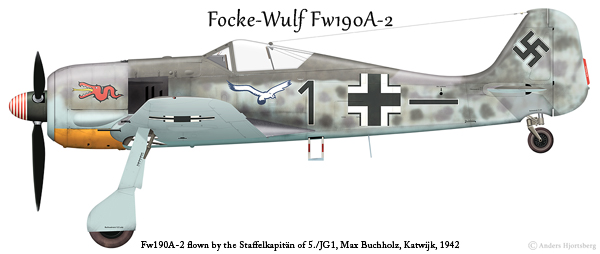
Fw190A-2 of Max Buchholz

https://drive.google.com/open?id=0BzT90eXSUSBVOUh0bUNRNWZDWE0

Fw190A-2 flown by Max Buchholz of 5./JG1 at Katwijk 1942 showing his personal sea gull emblem that could also be seen on his Bf109F and Fw190A-5. I've been busy with commision work for a while but hopefully will be able to update a little more frequently once my Fw190 template evolves.


Saturday, March 12, 2016

Bf109E-4 of Wilhelm Balthasar - 1559 part 1

https://drive.google.com/file/d/0BzT90eXSUSBVamRKNXppc3BwcDA/view?usp=sharing
White 1 of Wilhelm Balthasar, a Bf109E-4 with the W.Nr 1559, served the Luftwaffe for a long period and went through many changes. The profile above shows the aircraft at the end of the Battle of France while Balthasar served as Staffelkapitän of 1./JG1. Although the aircraft looks very clean, some details points to a recent repaint. 

https://drive.google.com/file/d/0BzT90eXSUSBVWXF3ZHZnMkd3dkE/view?usp=sharing
The next profiles show the aicraft looking very similar but a bit more weathered. The white rudder and wing tips were only used in the first week of September 1940. At that time, Balthasar had just began his service as Gruppenkommandeur of III./JG3. Strangely, the markings from Balthasars time with 1./JG1 was still retained. (1./JG1 had since then been redesignated as 7./JG27)

https://drive.google.com/file/d/0BzT90eXSUSBVSlR6cEFKQ21KajQ/view?usp=sharing 
At the end of September 1559 had gone through several changes including a new III./JG3 emblem, heavily mottled sides that appeared to have been brush painted on around the emblems and a yellow nose and rudder. It appears that the yellow paint adhered very poorly to the brush painted areas where the diagonal part of the yellow cowling can be seen to be flaking very badly. 


https://drive.google.com/file/d/0BzT90eXSUSBVREdBRFcwbFpEeU0/view?usp=sharing 
Later in 1940 a green "1" and horizontal bar was added to the markings. It is unclear when this was done but seems likely to have been done before Balthasar handed over the command of III./JG3 and 1559 to Walter Oesau. 

Monday, April 28, 2014

Bf109G-14 of Jakob Vogel at the Battle of Britain pub, Gravesend.

http://www.cptfarrels.com/blog/Bf109G-14_Vogel_JG1 1200.jpg

Browsing through the LEMB section "Luftarchaeology & surviving parts" I discovered photos taken by member and moderator Clint Mitchell depicting a fin and rudder from a Bf109G, that is on display at the Battle of Britain pub in Gravesend outside London. The history of this relic was not completely clear as the W.Nr wasn't decipherable. Seeing that the detail in the photos proved this relic to be from a Bf109G-6 or G-14 in either the 412-413 or 460-462 range built by Erla, it was at least possible to narrow down the search somewhat. On a hunch I did some searching in Marc-AndrĂ© Haldimann photo archive and soon realized that there was an aircraft within that W.Nr range that had been brought to Farnborough, namely Black 7, W.Nr 413601, that Jakob Vogel of 8./JG1 bellylanded behind British lines in Normandy on July 22, 1944. 

Examining photos of this aircraft, both from the bellylanding and recovery as well as one photo taken in a hangar at Farnborugh it quickly became apparent that the mottle is identical with that on the fin and rudder displayed at the Battle of Britain pub. So, somehow, Jakob Vogels Bf109G-14 that came down in Normandy almost 70 years ago, ended up on a wall in Gravesend and is still there today. A wonderful relic.  

Picture courtesy of Clint Mitchell 


EDIT: I've changed the outline to the numeral from white to yellow as yellow outlines seems to have been standard in 8./JG1. One picture of Black 7 is overexposed, the other is slightly out of focus so it's hard to determine the actual outline color. Photos of both earlier and later 109's from the unit does clearly show a yellow outline though.

Info about the pub where the rudder is located can be found here: http://www.battle-of-britain.eu/


Saturday, December 7, 2013

Bf109G-6/AS from JG1

http://www.cptfarrels.com/blog/Bf109G-6AS White 1 JG1_1200.jpg
A Bf109G-6/AS from 9./JG1 based at Anklam in the autumn of 1944. The all RLM 76 Bf109G-6/AS fighters were used by III./JG1 in their role as topcover escorts for the heavily armed Fw190's of the Geschwader tasked with attacking the 8:th airforce bombers. The antenna is mounted on the fuselage, an indication that this aircraft was originally fitted with a standard canopy. An indication that this could be a regular Bf109G-6 converted to G-6/AS standards. 

Don't forget that you can click the profiles for a higher res version!

Sunday, October 28, 2012

JG1 Erla built Bf109G-10


This Erla built Bf109G-10 might possibly be the most featureless profile I've done. Discreet was the order of the day when this aircraft was flown by Lt. Hubert Heckmann of 9./JG1 at Anklam in March 1945. 

Photos in Eric Mombeek's "Defenders of the Reich" volume 3 show this aircraft with the lower gear doors removed to prevent build-up of mud. According to the caption the aircraft was marked "White 13" but only the "1" is visible so the shape of the "3" is based on other aircraft from JG1. The aircraft seems to be from the 491xxx or 150xxx W.Nr. batches and I've painted it accordingly. During this period the transistion to unpainted wing undersurfaces had begun but it's hard to tell whether this aircraft had them or not. 

Wednesday, April 20, 2011

The Bf109G-6 flown by Friedrich Eberle in the autumn of 1943


This aircraft was photographed in October 1943 showing the White tail and the large white chevron outlined in a black and most likely yellow. Later on, in November or December of 1943 the aircraft was photographed again, this time showing the "White 20" and everything forward of that. 

It's obvious from details in the camo and the overpainted chevron that it's the same aircraft. It's known that when the new JG1 emblem was painted on to the noses of JG1 aircraft, the red tailbands were added too, as was the gruppe bar for III gruppe. So while the markings aft of the balkenkreuz are speculative in the second profile, they are likely correct.

On January 31, 1944, Eberles machine was caught on film agan, this time by the guncamera of an allied fighter. While the photage is grainy it clearly shows a nonstandard wing camoflage pattern and light grey tape over the wingtipjoints.