Showing posts with label Bf109G-6. Show all posts

Sunday, November 30, 2025

JG1 in Normandy - Friedrich Zanders Blue 22

 
During its time in Normandy after the invasion, the Gruppenstab of III./JG1changed its markings from white numerals to blue. There's photos of Blue 22 and Blue 23 that shows this practice which is also confirmed by the loss lists. 

The photos of Blue 22  shows the area below the cockpit up to and including the numerals and a part behind the Balkenkreuz. The camouflage and stencils proves that Blue 22 was built by Mtt Regensburg and the III./JG1 loss lists shows several aircraft in the 165.xxx W.Nr batch. 

Details in the paintwork seems to confirm this, pointing towards the tall tail version found within the 165.xxx batch. I've finished the profile accordingly. Although markings were simple during the Normandy campaign, most aircraft seems to have had spinner spirals applied as it was an important I.D. marking.


Friday, July 4, 2025

Bf109G-6 of Geschwaderstab JG3


Having jumped into a conversation on which Luftwaffe units were involved in the response to an 8:th airforce raid on Berlin on April 29:th 1944, it was evident that among others, JG3 participated with its Geshwaderstab, I, II and IV Gruppen. I started looking into how aircraft of these units would have looked like at the time and found a picture of the above aircraft that belonged to the Geschwaderstab of JG3, photographed at Salzwedel in the spring of 1944. It's a WNF built Bf109G-6 with a retrofitted Erla canopy. 


Monday, April 21, 2025

Bf109G-6 of 9./JG51


This Bf109G-6 from 9./JG51 is well documented thanks to a series of photos taken in the spring of 1944 at Brasnowitschi airfield. This includes a photo that shows the wing pattern to be a non standard one. This is actually an Erla built aircraft that would have left the factory in the saw tooth camouflage but evidently it was repaired and/or repainted at some stage. The fuselage looks as if it too has been modified although not as heavily as the wings.  

Friday, February 21, 2025

Bf109Ga-6 from 1./JG27


Bf109Ga-6 from 1./JG27 at Fels am Wagram in early 1944 as seen in the Wochenschau n° 707. The early style fuselage cross is typical for early Ga-6's i.e G-6's license built by Györ in Hungary. 

Saturday, November 16, 2024

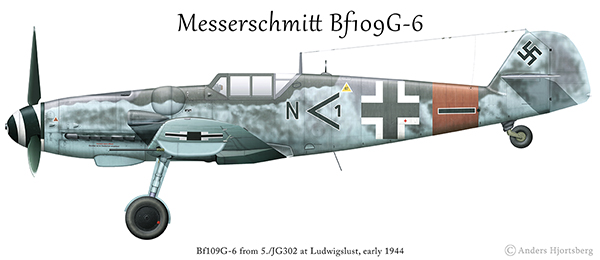
Bf109G-6 from 5./JG302


This aircraft served with 5./JG302 and was used in the Wilde Sau nightfighter roll, evident from the fact that the starboard wing under surface was black. Another interesting feature is the missing head armour which wasn't uncommon on Wilde Sau aircraft.

Wednesday, February 14, 2024

Bf109G-6 of Heinz Hunig, 5./JG2


Schwarze 12, W.Nr 27 083, of Heinz Hunig, 5./JG2 at Juvincourt, autumn 1943. Hunig was lost in this aicraft on October 20:th 1943. It's a striking aircraft with the yellow trim on the numerals and an interesting wingroot decoration. I created the profile for a decal sheet that never happened so now I'm posting it on my blog with the goal of posting more than once every other year! 

The pattern of the wing camouflage is interesting as it doesn't match the regular saw toothed pattern of Erla built aircraft. The 27.xxx W.Nr batch seems to be an anomaly in that regard. 


Thursday, December 24, 2015

Bf109G-6 at Wunsdorf

https://drive.google.com/file/d/0BzT90eXSUSBVbGhRLWNZU1VCUms/view?usp=sharing
A very colorful Bf109G-6 found at Wunsdorf by Canadian troops at the end of WWII. The camoflage scheme seems to consist of a base of late war colors taken down the sides of the fuselage, on top of which a light color has been mottled. In the profile I've opted for RLM 02 for the mottles. This color seems to give the most correct contrast with the darker colors. What's interesting is that there seems to be a dapple of darker spots at the lower part of the fuselage that are darker than both main colors of the camouflage. 

More than one aircraft has been found in this scheme so it's certainly not a one off. The question is whether it might have been an enhanced version of the austerity scheme seen on Erla built Bf109G-10's or something else completely. The WNr's of these aircraft shows that they were all old aircraft that had had a major overhaul at a repar facility which might be the origin of all the aicraft in this intriguing scheme. Similar spots were found on the noses of some Fw190D-9's and on the sides of a few Me262's though so there might have been a more elaborate plan with the use of this scheme. 

No "Christmassy" profile from me this year either, but a Merry Christmas to all nevertheless!

Friday, May 9, 2014

Bf109G-6 of Wilhelm Schilling, 9./JG54

http://www.cptfarrels.com/blog/Bf109G-6_Schilling_JG54_1200.jpg
Willhelm Schillings Yellow 1 as it looked in February 1944 at Ludwigslust. Several publications are giving the W.Nr for this aircraft as 440 141 which is a WNF W.Nr. The relase of Eduards 1/48 Bf109G-6 includes decals for this aircraft and the instructions are consequently showing a wing pattern  for a WNF aircraft too. The problem is that the camouflage on the fuselage of this aircraft is a very typical Erla camouflage. 

Going through a JG54 losslist compiled by Bob Wartburg I found two entries for a Yellow 1 flown by Schilling on the same date in February 1944. One is the aforementioned 440 141 and the other is 27 068. Now 27 068 IS an Erla built Bf109G-6 so it's also quite likely the correct W.Nr for this particular Yellow 1. This also means that the wings would have had the saw toothed pattern rather than the WNF one.

For a run down of the various pattern, check my previous blog post on the subject!

Saturday, November 16, 2013

Bf109G-6 found at Kassel

http://www.cptfarrels.com/blog/Bf109G-6_TT_Yellow 5_1200.jpg

This Bf109G-6 was found by US troops at the Henschel Aero Engine works in Kassel. The colorphoto of this aircraft is quite wellknown but new B&W photos of this aircraft has surfaced revealing more interesting detail. The enginecowling is a replacement in a different camoflage than the rest of the aircraft. Interestingly, it's mottled all over, there's no color covering the top as on regular camoflage schemes for the 109. The starboard wing also seems to be a replacement, the color of the undersurface being different than the rest of the aircraft but very similar to the enginecowling. In all likelyhood, a replacement in RLM 74/75/76. The port wing has the same color as the main fuselage but with some natural metal showing through. 

All that aside, the most interesting detail to me is that the close-up pictures shows a complete set of stencils on the fuselage, more or less proving that Bf109G's was at least to some extent delivered from the Mtt Regensburg factory in latewar colors.

Update: Thanks to some questions from John Irwin I've been able to see some new details and the profile has been updated accordingly. 

Monday, September 9, 2013

JG3 Bf109G-6s in Normandie with green tailbands

A JG3 shield combined with a green fuselageband seems like a strange combination! A B&W photograph of this aircraft shows the dark tailband to good effect and intelligence reports on captured enemy aircraft in Normandy shows that several aircraft were found wearing the JG3 shield and a green fuselageband.

The most likely explantion would seem to be that JG27 aircraft were transferred to other units in Normandie and given the hectic and chaotic situation, new individual markings were added while the bands remained in place. 

Tuesday, June 26, 2012

Bf109G-6 from 5./JG52


A very low resolution photo of this aircraft turned up on Ebay some years ago, as far as I can remember no details were known. Looking at the style of the markings with the small numerals and yellow band directly aft of the balkenkreuz it seems highly likely to be a 5./JG52 aircraft. 

In fact, the markings are almost identical to the ones on the famous Black 15 flown by Walter Wolfrum. The medium color spinner looks like it could be red, just like on Black 15. Given the high number and red spinner it may even have been Walter Wolfrums reserve aircraft but that is pure speculation.

Friday, April 27, 2012

Slovak Bf109G-6

This profile was done at the request of an enthusiast who wanted this particular aircraft done so that he could have it printed and put on his wall. He sent me the references and I did the job, sending and discussing previews as the work went along. I'd be more than happy to work like that with anyone interested in having a particular profile created.

Contact me if you're interested!

Thursday, April 26, 2012

Bf109G-6 of Heniz Knoke


This is one of the many Bf109G's flown by Heinz Knoke with 5./JG11 in 1943. It's hard to tell the Wrk.Nr in the pictures but the camoflage, early style tailwheel and tall antenna post points to early WNF production. That means that there's a possibilty that the aicraft also had spoked wheels.

Wednesday, April 20, 2011

The Bf109G-6 flown by Friedrich Eberle in the autumn of 1943


This aircraft was photographed in October 1943 showing the White tail and the large white chevron outlined in a black and most likely yellow. Later on, in November or December of 1943 the aircraft was photographed again, this time showing the "White 20" and everything forward of that. 

It's obvious from details in the camo and the overpainted chevron that it's the same aircraft. It's known that when the new JG1 emblem was painted on to the noses of JG1 aircraft, the red tailbands were added too, as was the gruppe bar for III gruppe. So while the markings aft of the balkenkreuz are speculative in the second profile, they are likely correct.

On January 31, 1944, Eberles machine was caught on film agan, this time by the guncamera of an allied fighter. While the photage is grainy it clearly shows a nonstandard wing camoflage pattern and light grey tape over the wingtipjoints.